

Cheap Attention Beats Expensive Repair
Almost every foundation problem in this region has water somewhere in its history. Saturated soil pushes harder on basement walls. Water moving through fill accelerates settlement. Sustained moisture decays crawl space framing. Runoff washes out support beneath flatwork.
Drainage maintenance is the least glamorous work associated with a foundation and by a wide margin the best value. Most of it takes an afternoon and costs nothing.
Our foundation drainage page covers what to do when maintenance is not enough. This guide covers what you can do before it gets there.
Gutters and Downspouts
Clear the gutters. Then, separately, watch them work during real rain, not a drizzle.
A gutter can be clear and still fail. A section with inadequate fall pools and overflows at the low point. An open joint drips continuously onto the same patch of soil all winter. A downspout clear at the top can be blocked at the elbow.
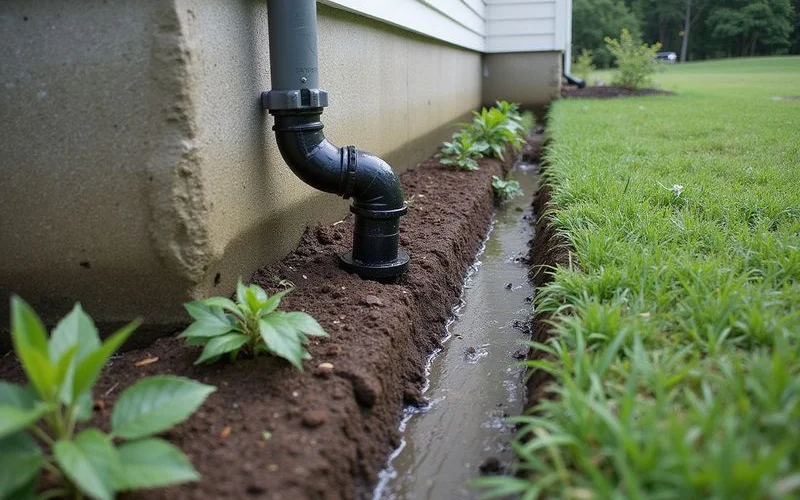
Then follow each downspout to its end. Three situations:
Good. Connected to a tightline carrying water well away from the building to a proper discharge.
Acceptable. Discharging onto an extension or splash block that moves water several feet from the wall onto ground that falls away.
A problem. Ending at grade beside the foundation, discharging into a planting bed against the house, or disappearing into a buried pipe nobody has confirmed still works.
That last one deserves attention. A collapsed or blocked buried downspout line delivers water below grade directly at the foundation while everything looks fine from the surface.
Grading
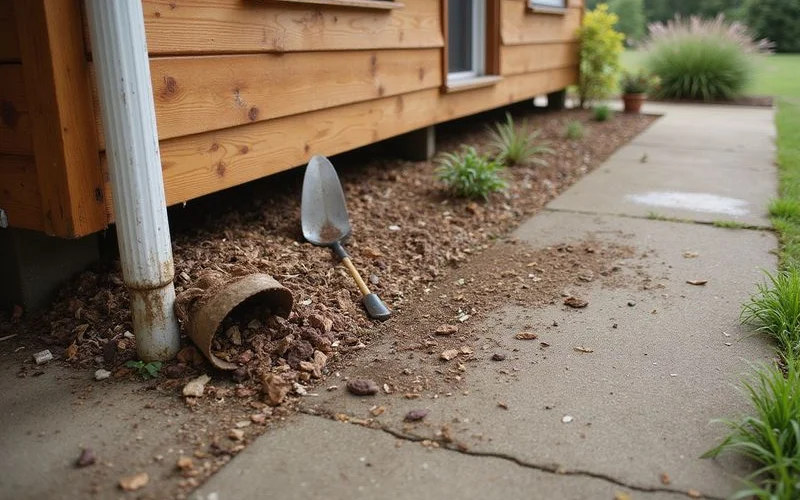
Ground within roughly the first ten feet of a house should fall away from it. Over decades this reverses quietly, mulch topped up each spring, beds built out, backfill settling, a path added.
You do not need instruments. Look along the wall. Does the ground slope toward the building anywhere? Is there a shallow depression running along it? Look for the evidence: a persistently soggy patch, a line of moss, darker soil, splash marks up the siding.
Correcting a reversed grade is inexpensive compared with almost anything else in this trade.
Drain Outlets
If the property has a footing drain, an interceptor drain, or a downspout tightline, that system discharges somewhere. Find the outlet.
Outlets block. Leaves pack in, soil creeps over them, rodents nest in them. An outlet 80 percent blocked looks fine from ten feet away and is useless at the flow rates that matter.
During sustained rain, water should be visibly discharging from it. A drain outlet that is dry while it is raining steadily is either not collecting or blocked, and both are worth knowing in October rather than in February.
Sump Systems
Test before each wet season rather than discovering the answer during a storm.
Pour water into the basin until the float lifts. Confirm the pump starts, moves water, and shuts off cleanly. Check that the basin has not silted, that the check valve holds, that the discharge outlet is clear, and that any battery backup still holds charge.
A pump that sat idle through a dry summer is exactly the sort of thing that fails on first demand.
The Seasonal Routine
| Check | When | Looking for |
|---|---|---|
| Gutters cleared | Autumn, and again mid-winter if trees are close | Debris, standing water in the trough |
| Gutters observed in rain | During genuine sustained rain | Overflow points, drips, blocked elbows |
| Downspout discharge | Autumn | Anything ending at grade near the wall |
| Grading | Any dry day | Ground falling toward the house |
| Drain outlets | During steady rain | Water actually discharging |
| Sump test | September or October | Starts, moves water, shuts off |
| Crawl space | While dry, and again in winter | Baseline versus wet-season condition |
Record What Changes
Dated observations are the cheapest diagnostic tool available.
Photograph cracks with something for scale, and date them. Note which doors bind and when. Record where water appears, on which elevation, and after how much rain.
That record turns “there’s a crack” into “this crack was this wide in March,” which changes what any evaluation can conclude.
When Maintenance Is Not Enough
Water entering a basement where it did not before. Standing water in a crawl space rather than dampness. A drain outlet that stays dry during heavy rain. A retaining wall that has visibly moved since last year. A crack measurably wider than your own dated photograph.
None of those are emergencies, and none require a decision this week. They are reasons to get an assessment with measurements rather than watching through another winter and wondering.
Understanding the system you have, and whether it is a footing drain, an interceptor drain, or neither, is covered in our guide comparing footing drains and interceptor drains.