
The Slab Is Rarely the Problem
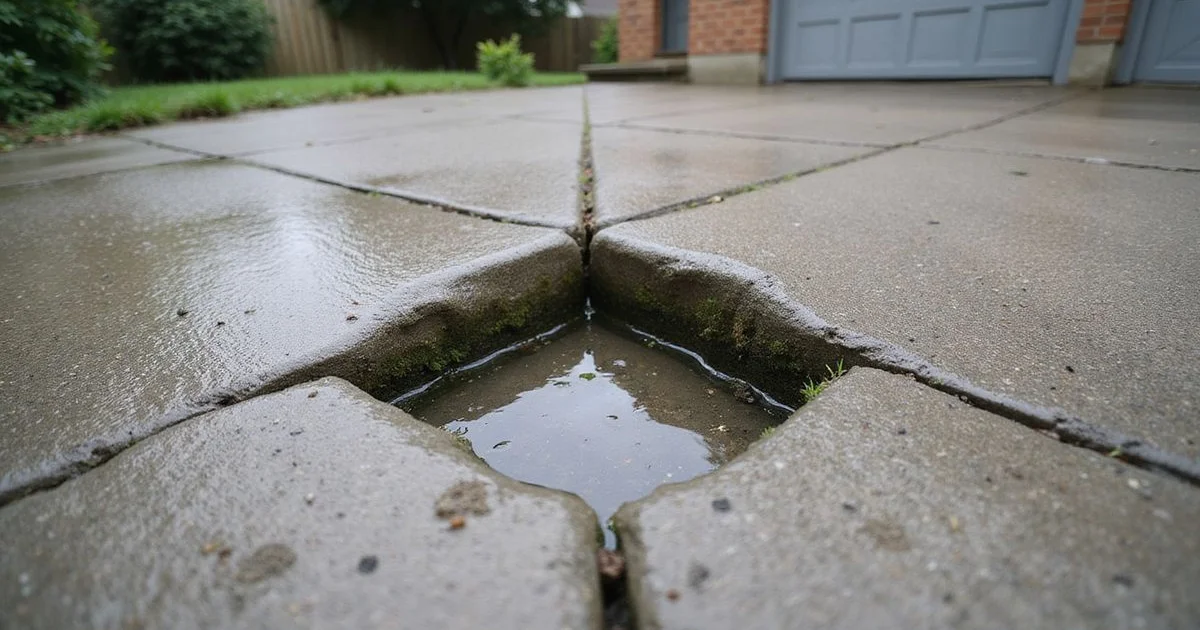
When a walkway panel drops or a driveway section sinks beside the garage apron, the concrete itself is usually sound. What changed is the support underneath it.
Concrete flatwork is a rigid plate bearing on soil. It has no deep foundation and no load path to anything competent. It relies entirely on the material directly beneath it staying where it was, at the elevation it was.
That is a more fragile assumption than most people realise, and concrete leveling exists because it fails routinely.
Washout
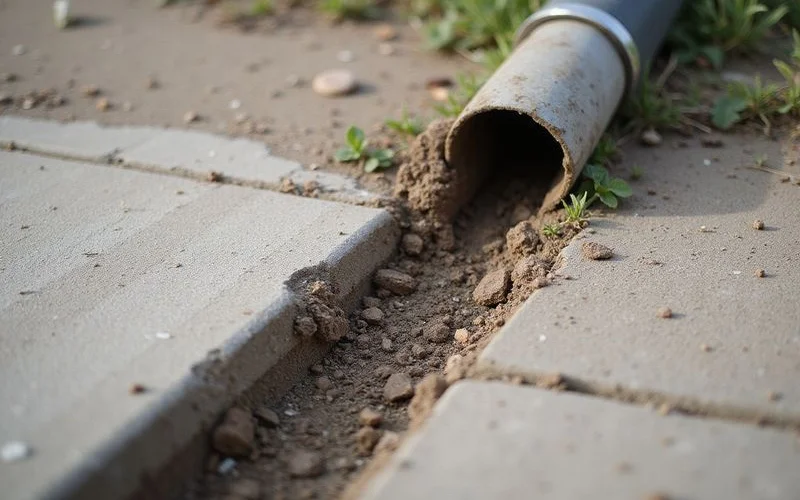
Water moving through soil carries fine particles with it. Over time, that transport removes material and leaves a void.
The usual sources are identifiable and frequently cheap to fix. A downspout discharging at the edge of a driveway or walkway concentrates a roof’s worth of water into one small area, every time it rains. A leaking supply line or a cracked drain beneath a slab does the same continuously and invisibly. Surface water following the same path along a slab edge for a decade hollows out the soil beside and beneath it.
Washout is the most common cause we see, and its defining characteristic is that it continues until the water source is corrected.
Poor Compaction
Fill placed beneath a slab at construction and never properly compacted consolidates under load and moisture cycling.
This shows up most often where a slab was poured over a backfilled trench, a utility line, a foundation excavation, a service run. The trench backfill settles relative to the undisturbed ground beside it, and the slab bridges the difference until it cannot.
The pattern is distinctive: a strip of settlement running in a line, rather than a general dish.
Sub-Slab Voids
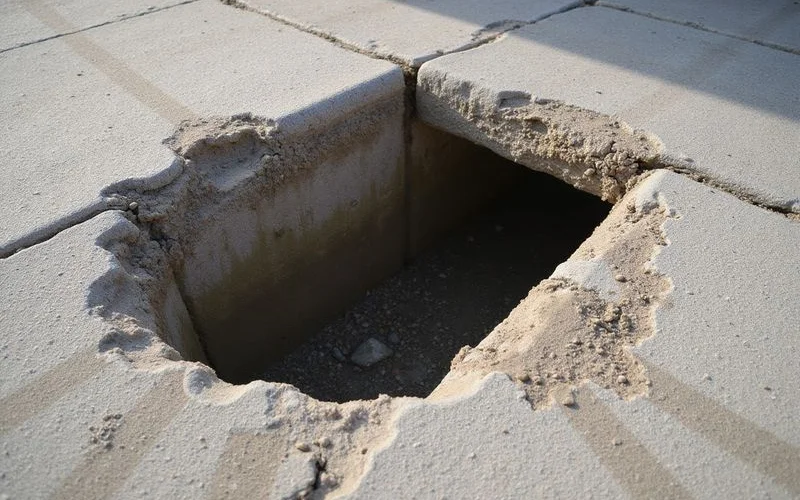
Whatever the cause, the intermediate condition is the same: a gap between the underside of the slab and the soil that used to support it.
Concrete is strong enough to bridge a small void for a while. That is why the settlement often appears suddenly, the slab was spanning a growing gap for months, and then a vehicle drove over it, or freeze-thaw cycling did the rest.
A void can frequently be detected before the slab drops, by the hollow sound when tapped near a joint.
Cracking Versus Settling
They are related but not the same.
Concrete shrinks as it cures and develops shrinkage cracks, which is why control joints exist, to decide where the cracking happens. Shrinkage cracking is normal and not an indication of settlement.
Settlement cracking is different: it occurs where a slab has been forced to span and has broken under its own weight plus load. The clue is displacement, one side of the crack sitting at a different elevation from the other, rather than a simple separation.
A slab can crack without settling and settle without cracking. Both together indicate the settlement was significant enough to break the plate.
Why This Region Produces So Much of It
Sustained rainfall provides the water. A great deal of Seattle fill is uncontrolled. Valley-floor properties in Renton, Kent, and Tukwila sit on alluvial soils with a high seasonal water table. Sloped lots concentrate runoff along predictable paths.
And a century of utility trenching across residential lots means a lot of slabs sit over backfill that nobody compacted properly.
What Comes Next
Where a void has formed and the slab is intact, lifting is generally viable: polyurethane foam injected through small ports fills the void and raises the slab back to grade in a controlled way.
Where the slab is badly broken, severely spalled, or sitting on soil that cannot support a lift, replacement is the better value and we will say so.
Either way, the cause has to be addressed. Filling a void while leaving a downspout discharging at the slab edge means doing the same work again in a few years, and it is the homeowner who pays for that, not the contractor. Our guide on lifting versus replacement covers how to weigh the two options.