
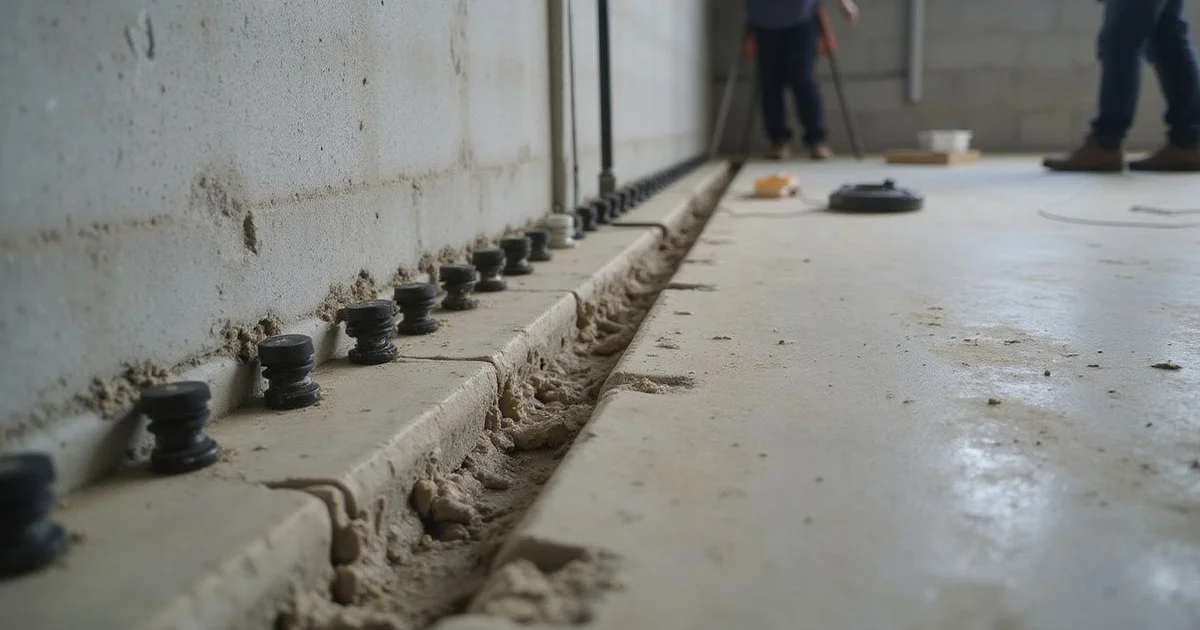
Four Treatments, Four Purposes
Basement wall repair suffers from a specific confusion: several treatments get discussed as though they were competing options for the same problem. They are not. They address different mechanisms, and choosing between them is a matter of what the wall is doing.
Our basement wall repair proposals keep them as distinct line items for exactly this reason. Here is what each one does.
Epoxy Injection
Purpose: restore structural continuity across a crack in poured concrete, and seal the path water was taking.
How it works. Ports are fitted along the crack, the surface is sealed between them, and low-viscosity epoxy is injected under pressure, filling the crack through the thickness of the wall. Cured epoxy is rigid and bonds the two faces so the section acts as one again.
When it applies. A dormant crack in a wall that is not deflecting, where restoring continuity is the goal.
When it does not. A wall that is moving. Epoxy is rigid, so continued movement opens a new crack, frequently right alongside the repaired one. Injecting a crack in a bowing wall treats the visible symptom and leaves the mechanism untouched.
Polyurethane Injection
Purpose: stop water passing through a crack.
How it works. Polyurethane is injected and expands on contact with moisture, filling the void and creating a flexible seal.
When it applies. Active water leakage through a crack, particularly where minor seasonal movement is expected and a rigid material would fail.
When it does not. Where the objective is structural continuity. Flexibility is the point of polyurethane, and flexibility is exactly what epoxy is chosen to avoid.
Carbon Fiber Reinforcement
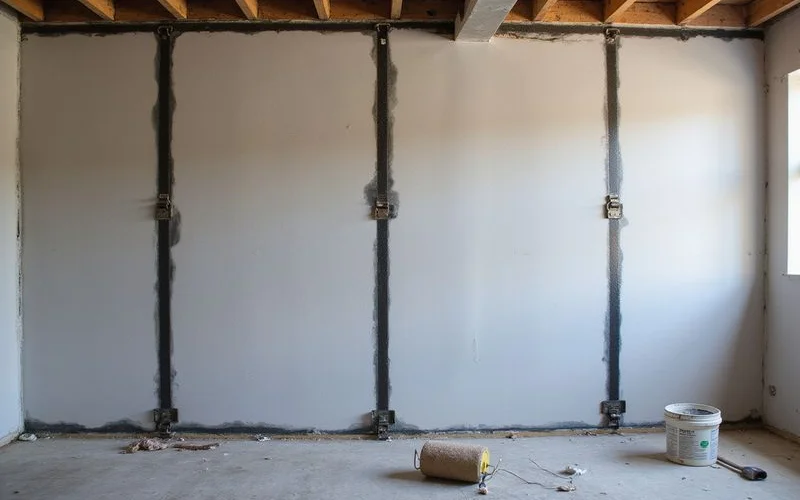
Purpose: resist further inward deflection of the wall.
How it works. High-tensile carbon fiber straps are bonded to the prepared inside face of the wall at specified spacing, running vertically. The wall is strong in compression and weak in tension; the straps supply tensile capacity on the face that is being stretched as the wall bends inward.
When it applies. Walls with limited deflection where the goal is arresting further movement. The near-flush profile matters if the basement will be finished.
When it does not. Walls with advanced deflection beyond what the system’s capacity addresses, and situations where recovering movement rather than arresting it is the objective.
Surface preparation is the whole system. Bonded reinforcement works through the bond. A strap applied to an unprepared, dusty, or damp surface is decorative.
Steel Bracing
Purpose: resist further deflection where greater capacity is required.
How it works. Steel I-beams are set vertically against the wall, anchored at the floor slab and to the framing above, transferring force from the wall into the structure.
When it applies. More advanced deflection than carbon fiber suits, and situations where the beams’ projection into the room is acceptable.
When it does not. Finished basements where the projection is unacceptable, and situations where anchoring at slab and framing is impractical.
Wall Anchors and Tiebacks
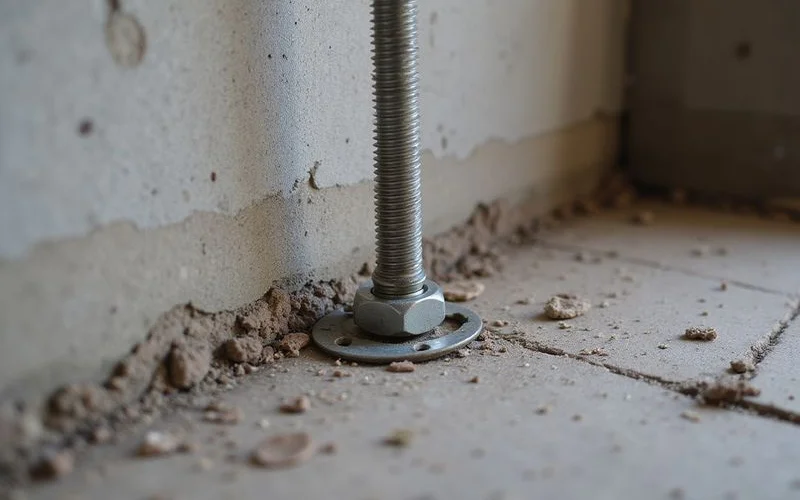
Purpose: resist the wall from outside, and in some conditions recover a degree of movement.
How it works. A rod runs from a plate on the interior wall face, through the wall, out to a deadman plate or a helical anchor set in stable soil beyond the zone that is pressing on the wall. Tightening the assembly resists the wall, and over time can draw it back gradually.
When it applies. Where exterior soil access is available and recovery of movement is a goal.
When it does not. Urban lots with a property line, a neighbouring structure, or hardscape where the anchor would need to go.
Choosing Between Them
| Situation | Appropriate treatment |
|---|---|
| Dormant crack, wall not moving, continuity wanted | Epoxy injection |
| Crack passing water, minor movement expected | Polyurethane injection |
| Limited deflection, basement to be finished | Carbon fiber reinforcement |
| More advanced deflection, projection acceptable | Steel bracing |
| Exterior access available, recovery desired | Wall anchors or tiebacks |
| Hydrostatic pressure contributing | Any of the above, plus drainage |
The last row matters. Reinforcement resists the load; drainage reduces it. Where water is a driver, addressing it means the reinforcement is not fighting a permanent headwind.
Why We Keep Them Separate in a Proposal
Structural repair and cosmetic sealing are different lines.
Sealing a crack costs one thing. Reinforcing a wall costs considerably more. Bundling them into a single figure hides which you are buying.
A proposal that offers crack sealing in response to measured deflection is addressing the symptom, and you should be able to see that from the document.
Selecting between these is determined by measured deflection, by whether movement is progressing, by finish plans, and by access. The carbon fiber versus steel comparison goes deeper on the two most common interior choices.