
Three Categories, Not One Product
Foundation repair is not a single procedure with variations. It is three distinct categories of work addressing three distinct mechanisms, and confusing them is the most expensive mistake a homeowner can make.
Underpinning addresses loss of vertical support. A footing has settled because the material beneath it could not carry the load, and the repair transfers that load to a stratum that can. This is the work covered on our foundation settlement repair page.
Reinforcement addresses lateral load. A wall is cracking or bowing because soil and water are pushing against it, and the repair adds capacity to resist that force.
Stabilisation and sealing address serviceability rather than structure. Crack injection, waterproofing, and drainage do not carry load; they manage water and restore continuity.
A settled footing does not need carbon fiber. A bowing basement wall does not need piers. A crack in a wall that is not moving does not need either. Getting the category right is most of the decision.
Underpinning
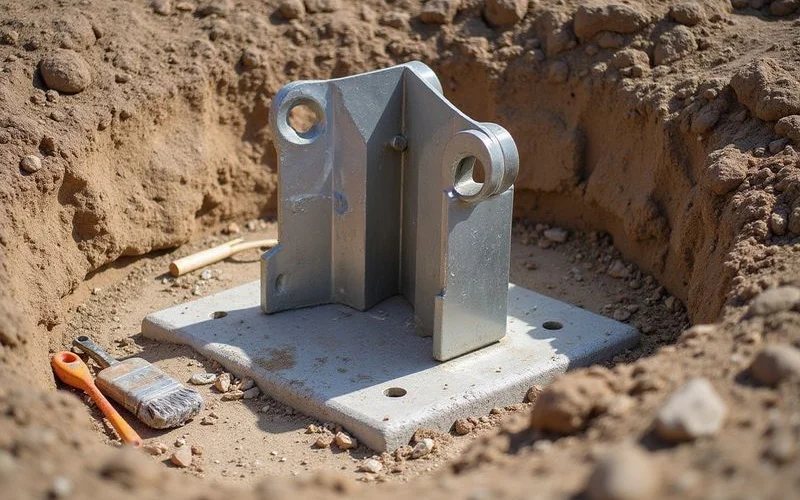
The principle is simple: bypass the problem soil and transfer the building load to something that can carry it.
In the Puget Sound region the target is frequently dense Vashon glacial till, though the depth at which it is encountered varies considerably across a single lot. Three systems dominate residential work, push piers, helical piers, and pin piles, and they differ in how the support is installed rather than in what it achieves.
Each has conditions it suits. Push piers use the weight of the structure as reaction force, so they need adequate building load. Helical piers are torqued in, with installation torque giving a measurable capacity indication, which suits lighter structures. Pin piles work where access is genuinely restricted. Our guide on helical piers, push piers, and pin piles compares them properly.
Underpinning is the appropriate answer when measurements show a footing has settled and the mechanism is loss of bearing. It is not an answer to lateral wall movement, and it is not a slope repair.
Reinforcement
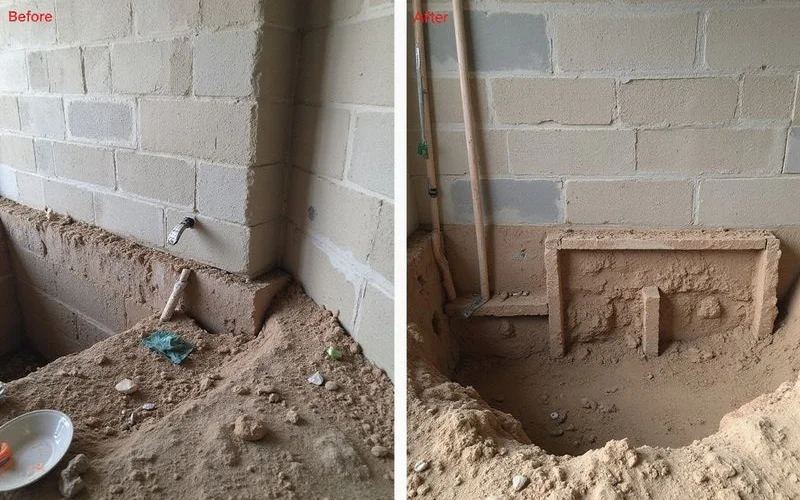
Where a basement or foundation wall is being pushed inward by soil pressure and hydrostatic load, the repair adds resistance rather than support.
Carbon fiber straps bond to the wall face at specified spacing and resist further bowing. They sit close to flush, which matters if the space will be finished, and they suit walls where deflection is limited.
Steel bracing anchored to the slab and the framing above provides greater capacity for more advanced movement, at the cost of projecting into the room.
Wall anchors and tiebacks resist the wall from outside using a deadman or helical anchor in stable soil, and can in some conditions recover a degree of movement. They require exterior soil access.
Reinforcement resists load. The complementary move is reducing that load through drainage, which is why wall repair and drainage frequently appear in the same project.
Stabilisation and Water Management
This category does not carry structural load, and treating it as though it does is where homeowners get hurt.
Crack injection, epoxy for restoring continuity in a dormant crack, polyurethane where stopping water is the goal and minor movement is expected.
Interior and exterior drainage, collecting and routing water so it does not build pressure against the structure.
Sump systems, removing collected water where gravity discharge is unavailable.
All of it is legitimate and often necessary work. None of it stops a footing settling or a wall moving. A proposal that offers crack sealing in response to measured structural movement is addressing the symptom.
What Drives the Selection
| Factor | Why it matters |
|---|---|
| Mechanism | Vertical settlement, lateral pressure, and water intrusion call for different categories entirely |
| Soil and bearing depth | Determines which underpinning system can reach competent material and at what cost |
| Loads | Push piers need adequate reaction load; lighter structures often suit helicals |
| Access | A narrow side yard or steep lot can rule out equipment and drive the method |
| Extent of movement | Limited deflection opens options; advanced movement narrows them |
| Finish plans | Whether a basement will be finished affects which reinforcement makes sense |
| Permitting | Critical-area review and engineering requirements affect timeline and cost |
When a Method Is Out of Scope
Some situations are outside what any foundation repair method addresses, and recognising them matters.
Slope movement. A pier transfers building load to a bearing stratum. It does not restrain a moving mass of soil. Where slope stability is the underlying question, that belongs with a geotechnical engineer.
Unreinforced masonry foundations. Anchoring and bracing approaches designed for poured concrete can transfer force into material that cannot accept it. Structural review is required.
Severe or unusual configurations. Where a building falls outside prescriptive approaches, engineered design is required rather than an approximation of one.
A contractor who will tell you when something is outside their scope is demonstrating something useful about how they will behave on the parts that are inside it.
The Order That Matters
Diagnose, then select. Measure the movement with an elevation survey, map the cracks, examine the substructure, understand how water behaves on the site, and only then discuss method.
Reversing that order is how a homeowner ends up with a technically competent installation of the wrong system. The work is done well, the invoice is fair, and the problem continues, because the problem was never the one being solved.