
All Three Do the Same Job Differently
Once an evaluation establishes that a footing has lost bearing and needs underpinning, the next question is which support system.
All three systems achieve the same thing: they transfer building load past the problem soil to a stratum that can carry it. What differs is how the support gets to depth, what determines when it has arrived, and which site conditions each suits.
Understanding the differences lets you ask a useful question of any contractor, not “is this a good system,” because all three are, but “why this one for my property.”
Push Piers
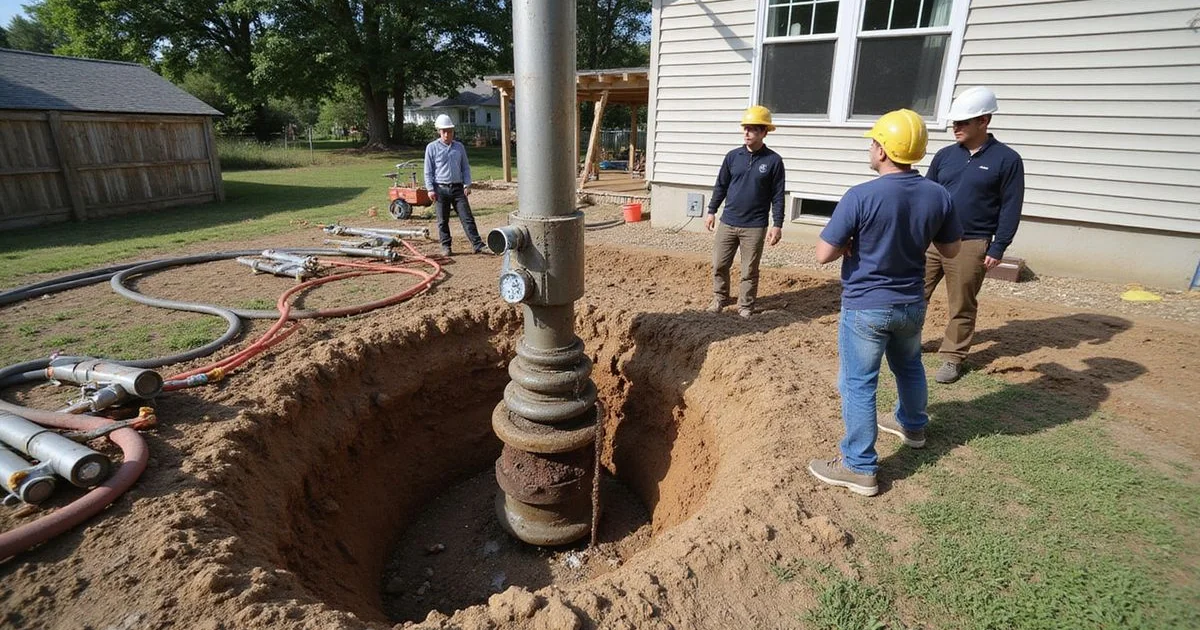
A push pier is a steel shaft driven vertically into the ground by a hydraulic ram, using the weight of the structure itself as the reaction force.
A bracket assembly is fixed beneath the footing, the ram pushes sections of shaft down through it one at a time, and the process continues until the shaft reaches refusal against a specified pressure. That pressure reading is the field indication that the pier has found competent bearing.
What it suits. Structures with enough dead load to provide adequate reaction. A two-storey house over a basement typically has plenty; a light single-storey addition may not.
The practical advantage. Because installation is driven by hydraulic pressure rather than rotation, push piers work in tight vertical clearance and the pressure record gives a direct installation criterion.
The limitation. Insufficient structural load means the shaft stops advancing before reaching bearing, which is not a useful outcome.
Helical Piers
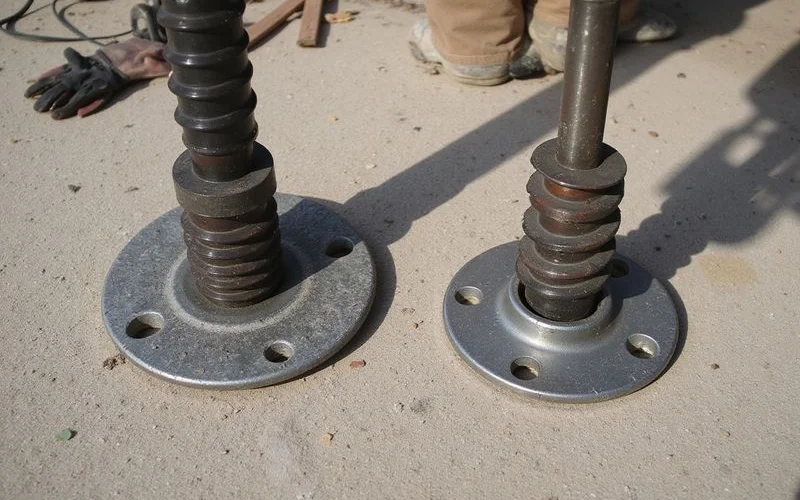
A helical pier is a steel shaft with one or more helix plates welded to it, advanced into the ground by a hydraulic torque motor. The helices pull the shaft down as it rotates, like a screw.
Installation torque correlates with capacity. As the helices advance into denser material, the torque required increases, and torquing to a target value gives a measurable installation record for each support.
What it suits. Lighter structures, additions, and situations where the building cannot provide reaction load. Also restricted-access sites, since the equipment can be relatively compact.
The practical advantage. The torque record is documentation. Each pier has a number associated with it, which is useful for the project file and for anyone reviewing the work later.
The limitation. Obstructions, cobbles, and certain soil conditions can impede advancement or produce misleading torque readings.
Pin Piles
A pin pile is a small-diameter driven pile, installed in sections and advanced to bearing.
What it suits. Genuinely restricted access, and situations where the target bearing layer is deep. On a Seattle side yard under four feet wide with a retaining structure on the property line, a pin pile approach may be what makes the project possible at all.
The practical advantage. Small equipment, small working room, and the ability to reach depth where other systems become impractical.
The limitation. Smaller section means more piles for the same capacity, which affects both cost and installation time.
Load Transfer and the Bracket
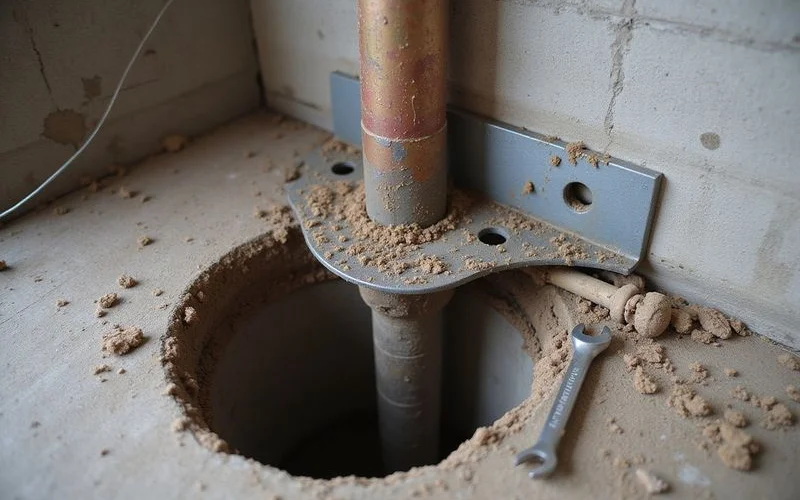
The pier itself is only half the system. The bracket assembly that transfers load from the footing to the shaft is the other half, and it is where a poorly executed installation shows.
The bracket must bear properly against sound concrete. Where the footing edge is deteriorated, spalled, or too narrow to accept the bracket, that has to be addressed rather than worked around. A pier driven to perfect bearing under a bracket that is not properly engaged has not achieved anything.
Steel specification matters too. Systems with ICC-ES evaluation reports have been assessed against a recognised standard, which gives a documented basis for the capacities being claimed. It is reasonable to ask which system a contractor uses and whether it carries such a report.
What Actually Drives the Choice
| Condition | Points toward |
|---|---|
| Heavy structure, adequate reaction load | Push piers |
| Light structure, addition, or limited reaction load | Helical piers |
| Need for a per-support installation record | Helical piers (torque) or push piers (pressure) |
| Severely restricted access | Pin piles or compact helical equipment |
| Deep target bearing stratum | Pin piles, or helicals with extensions |
| Obstructions or cobbles expected | Push piers may advance where helicals struggle |
Most Seattle residential projects can be executed with more than one of these. The right question is not which system is best in the abstract but which suits the combination of conditions on your lot, and a contractor carrying all three can answer that on merit rather than on inventory.
What Piers Do Not Do
A pier supports a designed load. It is not a universal fix.
It does not stabilise a moving slope. It does not resist lateral pressure on a basement wall. It does not stop water entering a basement. It does not address crawl space framing that has failed.
Where any of those is the actual problem, a pier installation will be technically competent, expensive, and beside the point.
Stabilisation Versus Lift, Again
Once piers are installed, there is a choice about how much of the lost elevation to recover. Stabilisation stops further downward movement. Lift attempts to bring the structure back toward its original position.
Maximum lift is frequently not desirable on an older house whose finishes have accommodated the settled geometry. A realistic recovery target, agreed in advance and stated in the scope, avoids trading a level floor for a set of new cracks in the plaster.
For the wider view of how pier systems sit alongside other repair categories, our foundation repair methods overview covers reinforcement and stabilisation work as well.