
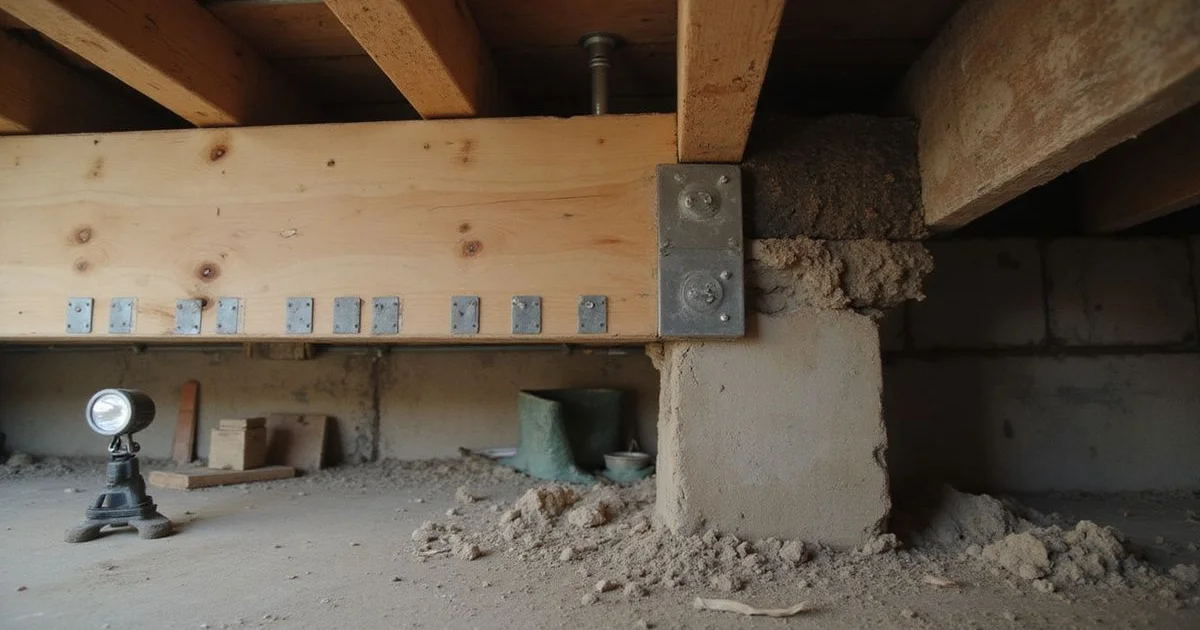
Decay Is a Structural Finding
Rotted framing is not a cosmetic problem or a housekeeping problem. Wood that has lost section has lost the capacity to carry the load it was sized for, and in a crawl space that load is your floor.
That said, discovering decay is not an emergency. It is a reason to establish how far it has gone, where it sits relative to bearing points, and what has been keeping the wood wet. Our crawl space repair evaluations do exactly that before proposing anything.
Where Decay Concentrates
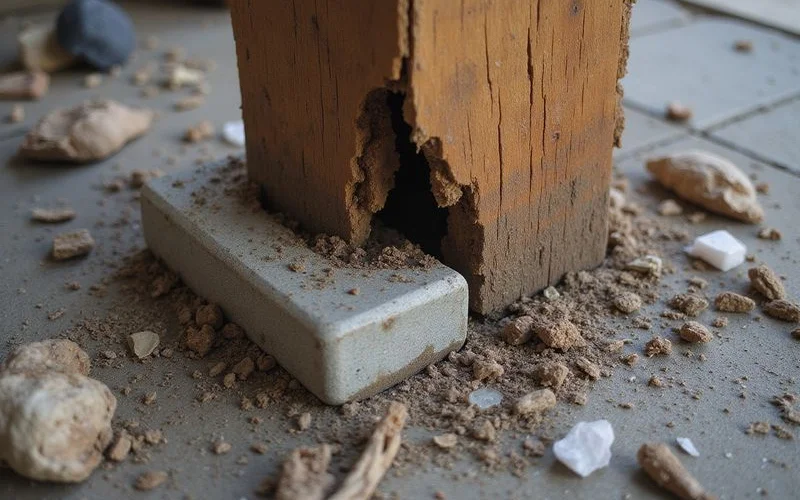
Decay follows moisture, and moisture concentrates in predictable places.
Post bases. Where a wood post meets a concrete pier block or, in older installations, the ground itself. Moisture wicks up, and the end grain absorbs readily.
Beam ends in wall pockets. A girder bearing into a pocket in the foundation wall sits in a confined space with poor air movement, against masonry that transmits moisture.
Sill plates. In direct contact with concrete around the full perimeter, and usually located exactly where exterior drainage problems deliver water.
Joist ends at the perimeter. Same exposure as the sill.
Notice the pattern: these are all bearing points. Decay in the middle of a joist span reduces capacity but leaves the bearing intact. Decay at a bearing point attacks where the load actually transfers, which is why location matters as much as extent.
Assessing the Extent
Visual signs come first: darkening, surface fungal growth, a stringy or cubical texture where fibres have broken down, and fruiting bodies in advanced cases.
Probing is more reliable. A screwdriver or awl pressed into sound wood meets firm resistance. Decayed wood accepts it, sometimes to a surprising depth beneath an intact-looking surface. Systematic probing at bearing points finds the great majority of what matters.
Moisture readings add context: whether the wood is currently wet, and therefore whether decay is likely ongoing rather than historic.
An audit records this member by member, with locations mapped, rather than concluding “there’s rot down there.” The map is what the repair scope is built from.
Sistering Versus Replacement
Sistering fastens a new member alongside the damaged one, with a specified fastening pattern and adequate bearing at each end, so the new member carries the load. It works where the existing member is compromised over part of its length and where sound bearing exists at both ends.
It is less disruptive and less expensive than replacement, and where it is appropriate it is a perfectly sound repair.
Replacement is required where section loss is severe, where decay runs through the bearing point so a sistered member would have nowhere to land, or where the original member was inadequate for the span regardless of condition.
Replacement often means temporary support while the old member comes out, which adds labour. Where a girder is being replaced, it is frequently the moment to size the new member properly rather than matching what was there, an engineered beam can address a span that has been marginal since 1925.
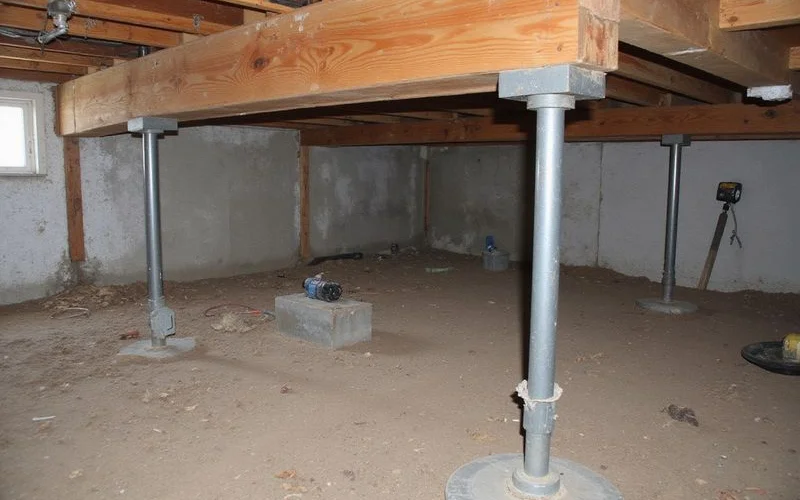
Post bases and pier blocks usually get replaced rather than repaired, with new reinforced footing pads sized to the load and adjustable steel posts on top.
Moisture Correction Is Not Optional
Repair without moisture control recurs.
Decay fungi need sustained moisture. Remove the moisture and the new framing stays sound. Leave the moisture and the new framing follows the old on a similar timescale.
That is why we scope moisture-source correction alongside framing repair rather than presenting it as an upsell. Paying twice for the same beam is avoidable and it is the customer who pays.
Depending on the pathway, that means drainage and discharge correction, grading, a ground vapour retarder, ventilation work, or full moisture control. The right combination depends on whether the problem is bulk water, ground vapour, or condensation, three different pathways covered in our guide on wet crawl spaces and damaged framing.
What We Do Not Handle
Mould remediation is licensed specialist work and it is excluded from our scopes. Where we find significant fungal growth beyond what is attached to structural members we are repairing, we say so and recommend the appropriate specialist.
Pest damage, carpenter ants, beetles, termites, is likewise a licensed specialty. It sometimes accompanies decay, because insects are attracted to wood that moisture has already softened, and the two findings can look similar to an untrained eye. We distinguish them in the report and refer what is not ours.
The Sequence
Correct the moisture source. Repair or replace the damaged framing. Restore support at bearing points with new footings and adjustable posts. Then, if warranted, install the moisture control system.
That order matters. A clean liner installed over decayed framing makes a crawl space look transformed while leaving reduced structural capacity under your floor, and the next person down there will reasonably assume it was dealt with.