
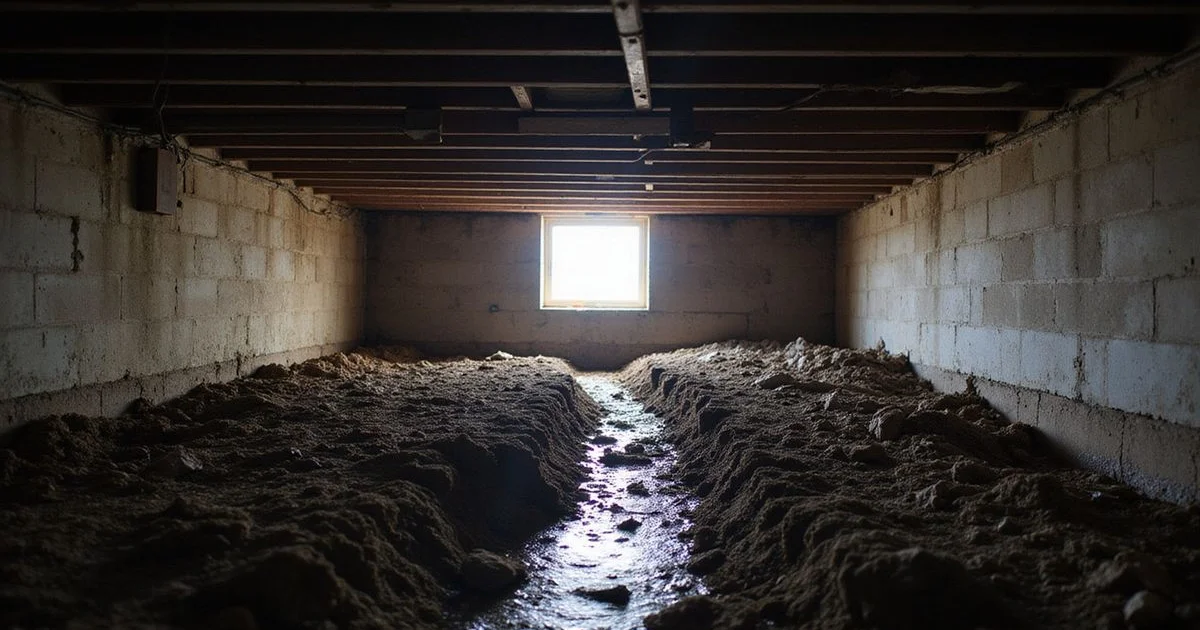
The Most Common Route Into Crawl Space Work
Most crawl space repair projects start the same way. Someone goes under the house for an unrelated reason, a plumber, a cable installer, an inspection before a sale, and comes back up saying it is wet down there and the wood looks bad.
That is a reasonable thing to act on. It is also worth understanding before panicking, because “wet crawl space” covers three different conditions with three different levels of concern.
Moisture Is Not Automatically Damage
Wood decay fungi need sustained moisture above a threshold. Below that threshold, wood can be damp for a long time without decaying.
What matters, then, is not whether the crawl space feels damp. It is whether the moisture has been sustained enough, for long enough, to let decay establish, and whether it has already done so.
A crawl space that gets humid through a Puget Sound winter and dries out by July is behaving normally for our climate. One with standing water in April, persistent condensation, or wood that has been wet continuously for years is a different matter.
Where the Water Comes From
Three pathways, and they are worth distinguishing because the fixes differ entirely.
Bulk water. Liquid water arriving from outside, surface runoff, a rising seasonal water table, a leaking supply or drain line, or groundwater through the soil. Shows as standing water, wet soil, or seepage at the perimeter. This is a drainage problem.
Ground vapour. Moisture evaporating from bare soil into the crawl space air. Continuous, and larger in volume than most people expect. This is a vapour retarder problem.
Condensation. Warm humid air meeting cool surfaces and depositing moisture. Peaks in summer, which is the opposite pattern to bulk water. This is an air management problem.
Our moisture control page covers how each is addressed. The point here is that a contractor who proposes a solution before identifying the pathway is guessing.
What Decay Does to Framing
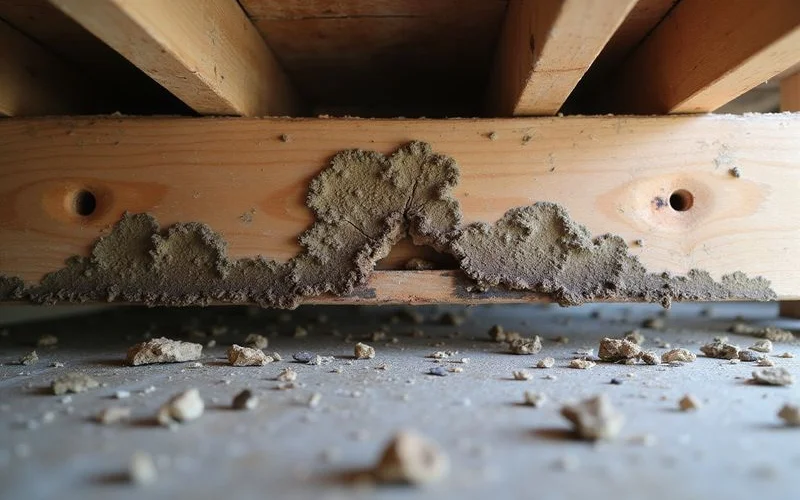
Wet rot progressively breaks down the structure of the wood, reducing its capacity to carry load. A joist that has lost a portion of its effective section still looks like a joist, and still holds up the floor, until it does not.
The locations that matter most are the bearing points, because that is where load concentrates and where moisture tends to linger.
Post bases. Where a wood post meets a pier block or the ground. Wicking moisture up from below is a classic pattern.
Beam and girder ends. Where a beam bears into a pocket in the foundation wall, moisture can be trapped with poor ventilation.
Sill plates. In contact with concrete, which transmits moisture, and frequently at the wettest part of the perimeter.
Joist ends. Where they meet the perimeter, usually the same area affected by exterior drainage problems.
Decay in the middle of a joist span is less structurally significant than the same decay at a bearing point. That is one reason a proper audit maps locations rather than reporting “some rot down there.”
What an Evaluation Examines
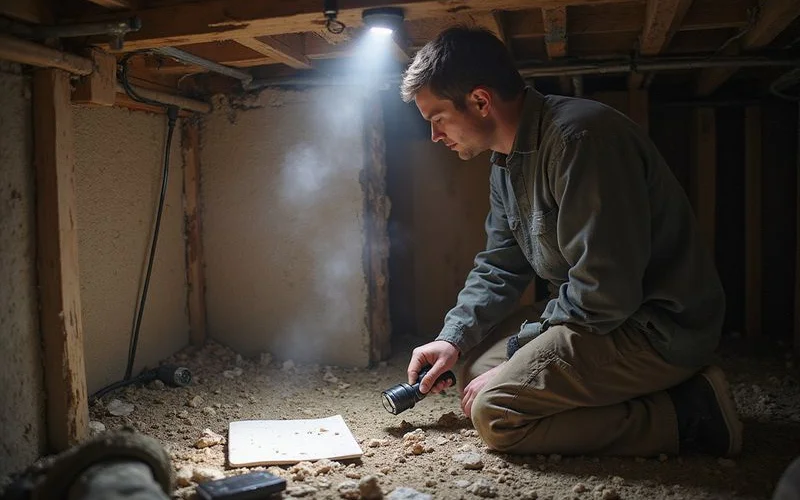
A substructure audit records, member by member:
Post base condition and pier block settlement. Girder spans, size, and measured deflection. Joist condition with probing where decay is suspected. Sill plate condition along the perimeter.
Moisture evidence: standing water, staining lines showing historic water levels, condensation patterns, and the condition of any existing vapour barrier.
Plus elevation readings on the floor above, which show where the structure has actually dropped and by how much.
Those two sets of information together define the repair extent. Without the elevation readings you are guessing which sag matters; without the audit you are guessing what caused it.
Symptoms You Might Notice Upstairs
You do not need to go under the house to suspect a problem.
Floors that feel springy or bouncy, particularly in the middle of a room. Floors that slope toward the interior rather than toward an exterior corner. A musty smell in rooms above the crawl space, worse in certain weather. Cold floors in winter. Doors within the interior of the house that have started to bind.
None of these are proof. All of them are reasons to look.
Order of Operations
Correct the moisture source first, or at least in the same scope. Framing repaired into an active moisture problem has a countdown on it, and paying twice for the same beam is avoidable.
Then repair the structure: sistering where partial decay allows it, replacement where section loss is severe, new reinforced footings and adjustable steel supports where post bases have settled.
Then, if warranted, the moisture control system, vapour retarder or full encapsulation with humidity management. That order matters, because installing a clean liner over unaddressed structural damage makes the crawl space look transformed while leaving reduced capacity in place, and the next person down there will assume it was dealt with.
Our guide on crawl space wood rot and framing repair covers the repair options in more detail.